

$54.99 Original price was: $54.99.$44.99Current price is: $44.99.
Yes, your gut really can affect your mood, and it works both ways. Your stomach and your brain are linked by nerves, hormones, and gut bacteria that send signals back and forth all day long. That’s why stress can upset your stomach, and why stomach trouble can leave you feeling low, tired, or on edge. Anxiety alone affects close to one in five adults in the United States each year, according to the National Institute of Mental Health. Here’s how this link works, what causes it to go off balance, and simple steps you can take to support both your gut and your mood.
Quick Glance
- Your gut and brain communicate constantly through nerves, hormones, immune signals, and gut bacteria.
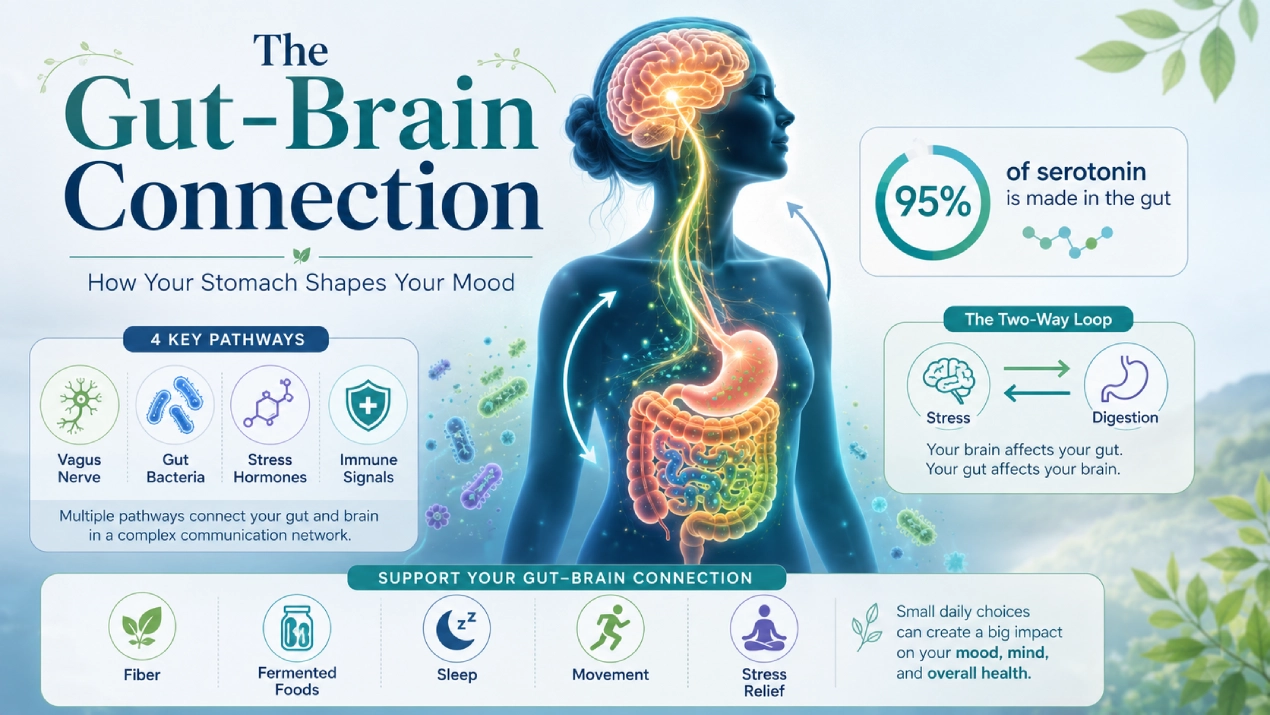
- About 95 percent of the body's serotonin is made in the gut, not the brain.
- The vagus nerve carries far more signals from gut to brain than brain to gut, roughly 80 percent versus 20 percent.
- Up to one in three people with IBS also deal with anxiety or depression, and the link runs in both directions.
- Fiber, fermented foods, sleep, and stress management are among the best-studied ways to support both gut and mood.
- Gut support can be part of a wellness routine. It is not a treatment for anxiety, depression, or any diagnosed condition.
What Is the Gut-Brain Connection?
Picture your gut and your brain as two people on a phone call that never hangs up. They’re always talking, day and night, even while you sleep. Doctors call this the gut-brain axis, but you don’t need the science term to understand the idea. What happens in your stomach affects how you feel. How you feel affects your stomach. It’s a loop, not a one-way street.
This isn’t a new idea either. People have said things like “trust your gut” or “butterflies in my stomach” for generations, long before anyone had the tools to study why. It turns out those old sayings were onto something real.
The gut-brain connection runs through four main paths:
- Nerves, mainly a long nerve called the vagus nerve
- Your immune system, when there's swelling or irritation in the gut
- Stress hormones, like cortisol
- Gut bacteria, which make chemicals that reach your brain
None of these four paths work alone. They overlap and feed into each other, which is part of why gut health and mental health are so hard to separate.
The Four Ways Your Gut and Brain Talk to Each Other
1. The Vagus Nerve: Your Body’s Main Wire
The vagus nerve is the longest nerve in your body. It starts at the base of your brain and travels down through your neck, your chest, and into your gut, touching your heart and lungs along the way. Think of it as the main cable connecting your control center to your digestive system. Johns Hopkins Medicine describes this network as a “second brain” living in the gut wall, made up of more than 100 million nerve cells.
Here’s the part that surprises most people. About 80 percent of the signals on this nerve travel from your gut up to your brain. Only 20 percent travel the other way. In simple terms, your stomach talks to your brain far more than your brain talks back. Your gut is not a quiet, passive organ. It’s constantly reporting back on what’s going on down there.
This nerve also plays a part in calming down swelling. When it senses irritation in the gut, it can send out a signal that helps settle it. This is called the body’s natural anti-inflammatory response, and it runs largely through this one nerve. Some animal studies found that when this nerve is cut, probiotics stop having any effect on mood or behavior at all. That tells researchers just how central this single pathway is to the whole system.
2. Your Immune System and Gut Lining
Your gut isn’t just a tube for digesting food. It’s lined with a thin wall that acts like a filter, letting nutrients through while keeping harmful substances out. When this lining is healthy, it does its job quietly in the background.
But stress, poor diet, and certain infections can weaken this lining over time. When that happens, small gaps can let bacteria and other particles slip through into the bloodstream where they don’t belong. This is sometimes called a leaky gut, though the more accurate term researchers use is increased intestinal permeability. Your immune system reacts to this leakage the same way it reacts to any threat, by triggering inflammation.
Ongoing, low-level inflammation like this has been linked to depression and other mood changes in several studies. The evidence is still developing and researchers are careful to call these findings early, but the pattern shows up again and again. A gut that’s under strain doesn’t just cause stomach discomfort. It can quietly stir up inflammation that reaches your brain too.
3. Stress Hormones and the HPA Axis
When you’re stressed, your brain sets off a chain reaction. It signals a gland near your kidneys to release cortisol, the main stress hormone. This system is called the HPA axis, and it’s meant to help you handle short bursts of stress, like reacting quickly to a real threat.
The problem is that most stress today isn’t short. Deadlines, money worries, and constant notifications keep this system switched on for far longer than it was built for. When cortisol stays high for weeks or months, it can change the balance of bacteria in your gut, weaken your gut lining, and reduce the helpful bacteria that normally keep things running smoothly.
Here’s the part that makes this a true loop. A gut that’s out of balance can send signals back up to the brain that make it even harder to switch off the stress response. So stress harms your gut, and a struggling gut can make you feel more stressed. Round and round it goes.
4. Gut Bacteria and the Chemicals They Make
Your gut is home to trillions of bacteria, often called your gut microbiome. This isn’t something to worry about. A healthy mix of these bacteria is normal and needed. They help you digest food, they help train your immune system, and they produce chemicals that affect your brain.
One group of these chemicals is called short-chain fatty acids. Your gut bacteria make them by breaking down fiber, and they help keep your gut lining strong while also supporting the nerve signals that travel up to your brain. When the mix of bacteria in your gut becomes unbalanced, a state doctors call dysbiosis, this whole chemical supply chain can be thrown off.
Some newer research has gone a step further, suggesting that an out-of-balance gut might actually help cause anxiety and depression, rather than just following along after them. This is a newer and still-developing area of study, but it’s one of the more exciting directions gut research has taken in recent years.
Why Serotonin Matters So Much
Here’s a fact worth knowing on its own. About 95 percent of your body’s serotonin, the chemical most linked to feeling good and staying calm, is made in your gut. Only about 5 percent is made in your brain.
This often gets oversimplified, so it’s worth slowing down here. Gut serotonin and brain serotonin are largely two separate systems. Serotonin made in your gut doesn’t travel straight up into your brain. Instead, it works locally, helping manage digestion, and it sends signals up through the vagus nerve. Those signals then reach the parts of your brain that manage mood, stress, and how you handle your emotions.
So your gut isn’t making your happiness directly. It’s helping set the tone for your whole nervous system, kind of like a thermostat that adjusts the temperature for the rest of the house. When your gut is working well, that signal tends to support steady, calm moods. When it’s struggling, that signal can get noisy and unclear. A 2025 research review on the vagus nerve and serotonin describes this exact pathway, from gut cells to the emotional centers of the brain.
The Stress-Gut Loop: A Closer Look at IBS
If you’ve ever felt your stomach churn before something stressful, or felt more anxious after days of stomach trouble, you already know this loop firsthand. Irritable bowel syndrome, or IBS, is one of the clearest real-world examples of how tightly connected these systems really are.
IBS causes stomach pain, bloating, and changes in bathroom habits, and it affects a large share of people at some point in their lives. A review published in Nature Reviews Gastroenterology & Hepatology found that up to one in three people with IBS also deal with anxiety or depression. And here’s the important part. Research shows this runs in both directions. Depression raises your risk of developing IBS, and IBS raises your risk of developing depression. Neither condition simply causes the other. They feed each other, back and forth, over time.
This matters for anyone who has been told their stomach symptoms are “just stress” or that their anxiety is “just in their head.” Neither framing tells the full story. The gut and the mind are both part of the same system, and treating one while ignoring the other often leaves people feeling stuck.
Common Causes of an Out-of-Balance Gut
A gut can fall out of balance for a number of reasons, and most people deal with more than one of these at once:
- A diet low in fiber and high in processed food, which starves the helpful bacteria that need fiber to thrive
- Long-term stress, which raises cortisol and changes the gut environment
- Poor or irregular sleep, which has been linked to lower variety in gut bacteria
- Frequent antibiotic use, which can wipe out helpful bacteria along with harmful ones
- Infections like H. pylori, a bacteria that can settle into the stomach lining and cause ongoing irritation
- Little to no physical activity, since regular movement supports a healthier mix of gut bacteria
- Heavy alcohol use, which can irritate the gut lining over time
Most people don’t have just one of these going on. It’s usually a mix, which is part of why gut imbalance can build up slowly without an obvious single cause.
Signs Your Gut Might Be Affecting Your Mood
You might not always connect the dots between how your stomach feels and how your mind feels. Some common signs worth paying attention to:
- Bloating or stomach trouble that shows up along with low mood or feeling on edge
- Trouble focusing, or a foggy feeling in your head, during rough patches of digestion
- Low energy that doesn't match how much sleep or rest you're actually getting
- Mood dips that seem to line up closely with stomach flare-ups
- Feeling unusually irritable or anxious after eating certain foods
- Trouble sleeping that seems to worsen alongside digestive discomfort
None of these signs alone prove that your gut is the cause of how you’re feeling. But if you notice a pattern, it’s worth paying attention to, and worth mentioning to a doctor.
Myths and Facts About Gut Health and Mood
There’s a lot of noise online about gut health, so it helps to sort out what’s solid and what’s overstated.
Fixing your gut will cure anxiety or depression on its own. Fact: Gut health supports mood, but anxiety and depression are complex conditions with many causes. Gut support can be part of a plan, not a replacement for proper care.
Any probiotic will help your mood. Fact: Results depend heavily on the specific strain. Some strains show real benefits in studies, while others show little to no effect. Quality and strain matter more than just taking "a probiotic."
Leaky gut is a made-up term with no science behind it. Fact: Increased intestinal permeability is a real, studied condition, though researchers are still working out exactly how much it affects mood in the general population. It's a real area of study, not a scare tactic.
Gut health only matters for digestion, not mental health. Fact: The research clearly shows this isn't true. The gut and brain are in constant, two-way contact, and gut health plays a real part in mood, stress, and mental clarity.
Simple Ways to Support Your Gut and Your Mood
You’re not stuck here. There are simple, everyday steps, backed by research, that support both your gut and your mood at the same time.
Eat More Fiber
Start with fiber. A large systematic review and meta-analysis covering more than 180,000 people found that higher fiber intake was linked to lower rates of depression and anxiety in observational studies. Fiber feeds the helpful bacteria in your gut, which then produce the short-chain fatty acids that support your gut lining and your brain signals. Good sources include vegetables, fruit, beans, oats, and whole grains.
Add Fermented Foods
Fermented foods introduce good bacteria straight into your gut. Foods like yogurt, kefir, sauerkraut, and kimchi are well-studied options. In controlled studies, people who added more fermented foods to their diet showed real, measurable changes in their gut bacteria and their overall wellbeing after just a few weeks.
Choose Probiotics Carefully
Probiotics can help, but not all of them work the same way. Some specific strains have shown real benefits for mood and stress in clinical trials, while others show little to no effect. This is an area where the specific strain matters far more than the word “probiotic” on the label.
Protect Your Sleep
Poor sleep is linked to less variety in gut bacteria, and gut imbalance can make it harder to sleep well in return. Aim for a consistent bedtime and wake time, even on weekends, since your gut bacteria seem to respond to routine as much as your body clock does.
Manage Stress on Purpose
Since cortisol directly affects your gut environment, managing stress isn’t just good for your mind. It’s good for your gut too. This doesn’t have to mean anything complicated. A short walk, slow breathing, time outdoors, or simply stepping away from screens for a while can all help bring cortisol down.
Move Your Body
Regular movement, even something as simple as a daily walk, has been linked to a healthier, more varied mix of gut bacteria. You don’t need an intense workout routine. Consistency matters more than intensity here.
Stay Hydrated
Water supports healthy digestion and helps keep things moving smoothly through your gut. It’s a simple step that’s easy to overlook.
Support the Root Cause
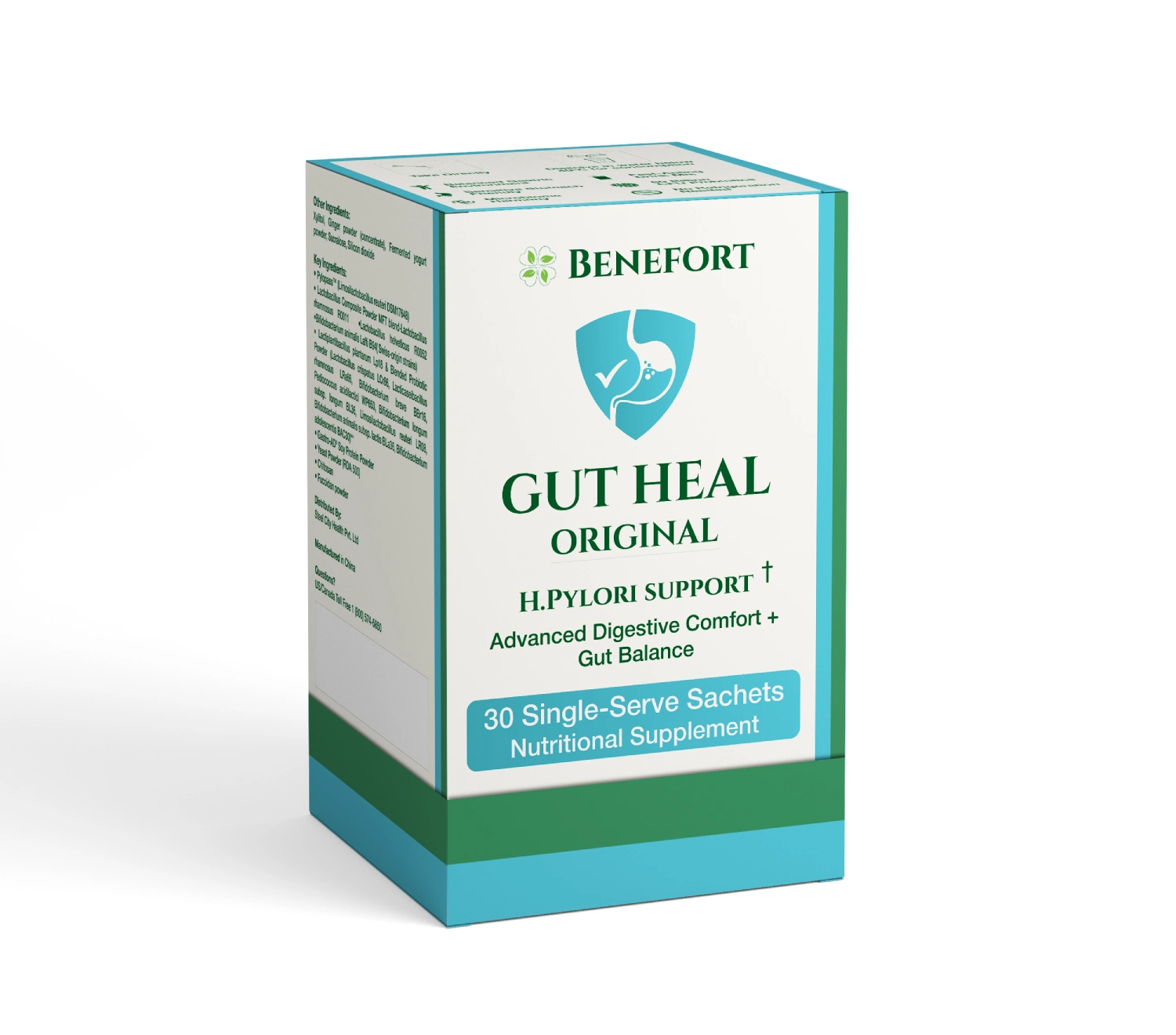
If your gut is already under strain, good habits alone may not be enough. It helps to also address what’s causing the imbalance in the first place. This is where GUTHEAL Original with Pylopass fits into the picture. Pylopass is a studied strain of Lactobacillus reuteri, DSM17648, shown in a placebo-controlled pilot study to lower H. pylori load in the stomach by binding to the bacteria so it can be cleared naturally. A later randomized, double-blind trial found it also improved the success rate of standard H. pylori treatment when used alongside it. GUTHEAL Original with Pylopass comes in a box of 30 sachets, made for daily use, and is designed to work alongside good food, sleep, and stress habits, not replace them. It’s one part of a full gut-support routine, not a treatment for H. pylori infection or any diagnosed digestive disorder on its own.
Foods That Support Gut-Brain Health
A short, simple list to keep on hand:
- Leafy greens and vegetables, for fiber
- Oats, beans, and lentils, for fiber and steady energy
- Yogurt and kefir, for live, active bacteria
- Sauerkraut and kimchi, for fermented variety
- Berries and other fruit, for fiber and antioxidants
- Nuts and seeds, for healthy fats
- Fatty fish like salmon, for omega-3s linked to brain health
You don’t need to eat all of these every day. Adding a few of them regularly tends to make a bigger difference than trying to do everything at once.
When Should You See a Doctor?
Everything above supports general gut health, but none of it replaces medical care. If you’re dealing with ongoing anxiety, depression, or stomach symptoms that affect your daily life, please talk to a doctor or a licensed healthcare provider. Mood changes and gut symptoms that stick around both deserve a proper check-up, not guesswork. A doctor can help figure out what’s actually going on and whether something more is going on beneath the surface.
Quick Answers
Does gut health really affect anxiety?
Yes. Research shows a real, two-way link between gut health and anxiety. An out-of-balance gut can add to feelings of anxiety, and anxiety can also throw off gut health in return.
Why is most serotonin made in the gut, not the brain?
About 95 percent of the body’s serotonin comes from cells lining the gut. It helps run digestion and sends signals to the brain through the vagus nerve, which shapes mood.
Can probiotics help with mood?
Some specific probiotic strains have shown mood benefits in clinical trials. Results depend a lot on the exact strain, so not every probiotic will have the same effect.
Is IBS linked to anxiety?
Yes. Up to a third of people with IBS also deal with anxiety or depression, and the link runs in both directions.
What foods support gut and brain health?
Fiber-rich foods and fermented foods like yogurt, kefir, and sauerkraut are two of the best-studied options for supporting both gut bacteria and mood.
What is leaky gut, really?
It’s a condition where the gut lining becomes more permeable than normal, letting particles slip into the bloodstream that don’t belong there. Researchers call it increased intestinal permeability, and it’s linked to inflammation that may affect mood.
How long does it take to improve gut health?
Some studies show measurable changes in gut bacteria within a few weeks of consistent habits like eating more fiber or fermented foods. Lasting change usually takes longer and depends on consistency over time.
Can stress alone cause stomach problems?
Yes. Ongoing stress raises cortisol, which can change your gut bacteria and weaken your gut lining, leading to real physical symptoms, not just a feeling of unease.
References
- National Institute of Mental Health. Anxiety Disorders. https://www.nimh.nih.gov/health/topics/anxiety-disorders
- Johns Hopkins Medicine. The Brain-Gut Connection. https://www.hopkinsmedicine.org/health/wellness-and-prevention/the-brain-gut-connection
- Hwang YK, Oh JS. Interaction of the Vagus Nerve and Serotonin in the Gut-Brain Axis. International Journal of Molecular Sciences, 2025. https://www.ncbi.nlm.nih.gov/pmc/articles/PMC11818468/
- Staudacher HM, Black CJ, Teasdale SB, Mikocka-Walus A, Keefer L. Irritable bowel syndrome and mental health comorbidity, approach to multidisciplinary management. Nature Reviews Gastroenterology & Hepatology, 2023. https://pubmed.ncbi.nlm.nih.gov/37268741/
- Aslam H, Lotfaliany M, So D, et al. Fiber intake and fiber intervention in depression and anxiety, a systematic review and meta-analysis of observational studies and randomized controlled trials. Nutrition Reviews, 2024. https://www.ncbi.nlm.nih.gov/pmc/articles/PMC11551482/
- Mehling H, Busjahn A. Non-viable Lactobacillus reuteri DSMZ 17648 (Pylopass) as a new approach to Helicobacter pylori control in humans. Nutrients, 2013. https://www.ncbi.nlm.nih.gov/pmc/articles/PMC3775242/
- Ivashkin V, Maev I, Poluektova E, et al. Efficacy and Safety of Postbiotic Contained Inactivated Lactobacillus reuteri DSM17648 as Adjuvant Therapy in the Eradication of Helicobacter pylori in Adults With Functional Dyspepsia, a Randomized Double-Blind Placebo-Controlled Trial. Clinical and Translational Gastroenterology, 2024. https://www.ncbi.nlm.nih.gov/pmc/articles/PMC11421730/
The Bottom Line
Next time you feel a knot in your stomach before something stressful, or notice your mood dip during a rough patch of digestion, know this isn’t just in your head. Your gut and your brain are always talking to each other, trading signals through nerves, hormones, and bacteria every hour of the day.
The good news is that small, steady habits add up. Eating more fiber, adding fermented foods, sleeping well, managing stress, moving your body, and supporting a balanced gut all work together over time, not overnight. If you’re looking for a simple place to start supporting your gut day to day, GUTHEAL Original with Pylopass is built to be part of that daily routine.
Editorial note: This article is for education only. It does not diagnose, treat, cure, or prevent anxiety, depression, IBS, H. pylori infection, or any digestive disorder.
This article was reviewed internally for source accuracy, product-label consistency, and claim compliance. It has not been medically reviewed by a physician. The content is for general information only and is not a substitute for professional medical advice, diagnosis, or treatment.
