

$54.99 Original price was: $54.99.$44.99Current price is: $44.99.
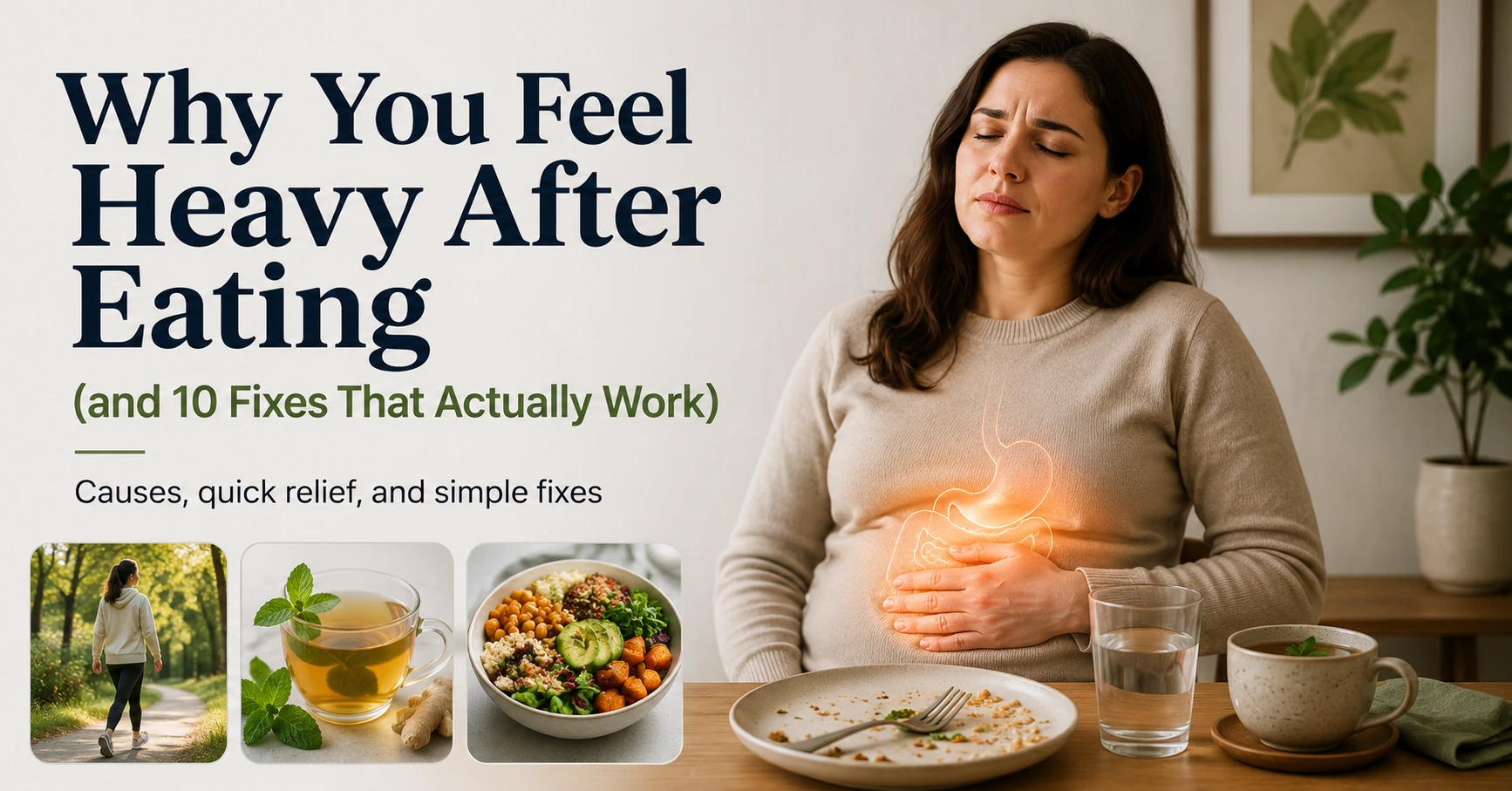
You finish a meal, sit back, and instead of feeling satisfied, you feel like you swallowed a brick. Your stomach feels tight, your energy drops, and all you want to do is lie down. This happens to most people at some point, and in almost every case it comes down to a handful of causes: how fast you ate, what was on your plate, or how well your gut is breaking things down. The good news is that once you know what’s driving it, the fixes are simple and mostly free.
What “Heavy After Eating” Really Means
When you eat, your body sends extra blood to your stomach and intestines to help digest the meal. Your stomach also stretches to hold the food, and it releases hormones that tell your brain you’re full. All of this is normal. But when a meal is too big, too rich in fat, or too fast to eat, these systems get overloaded. The result is that dense, weighed-down feeling that can last anywhere from a few minutes to a couple of hours.
For most people, this is nothing to worry about. It’s your body working through a heavy workload, not a sign that something is wrong. Where it becomes worth paying attention to is if it happens after every meal, even small ones, or if it comes with other symptoms like pain or vomiting. We’ll cover exactly when that line gets crossed later in this post.
It also helps to know that “heavy after eating” isn’t quite the same thing as feeling bloated or feeling tired after eating, even though the three often show up together. Bloating is mostly about gas and visible stomach swelling. Post-meal tiredness, sometimes called a food coma, is mostly about blood flow and hormone shifts making you sleepy. Heaviness sits in between the two: it’s the dense, weighed-down sensation in your stomach itself. Most of the causes and fixes below overlap across all three, so improving one usually helps with the others too.
Why It Happens: 7 Real Causes
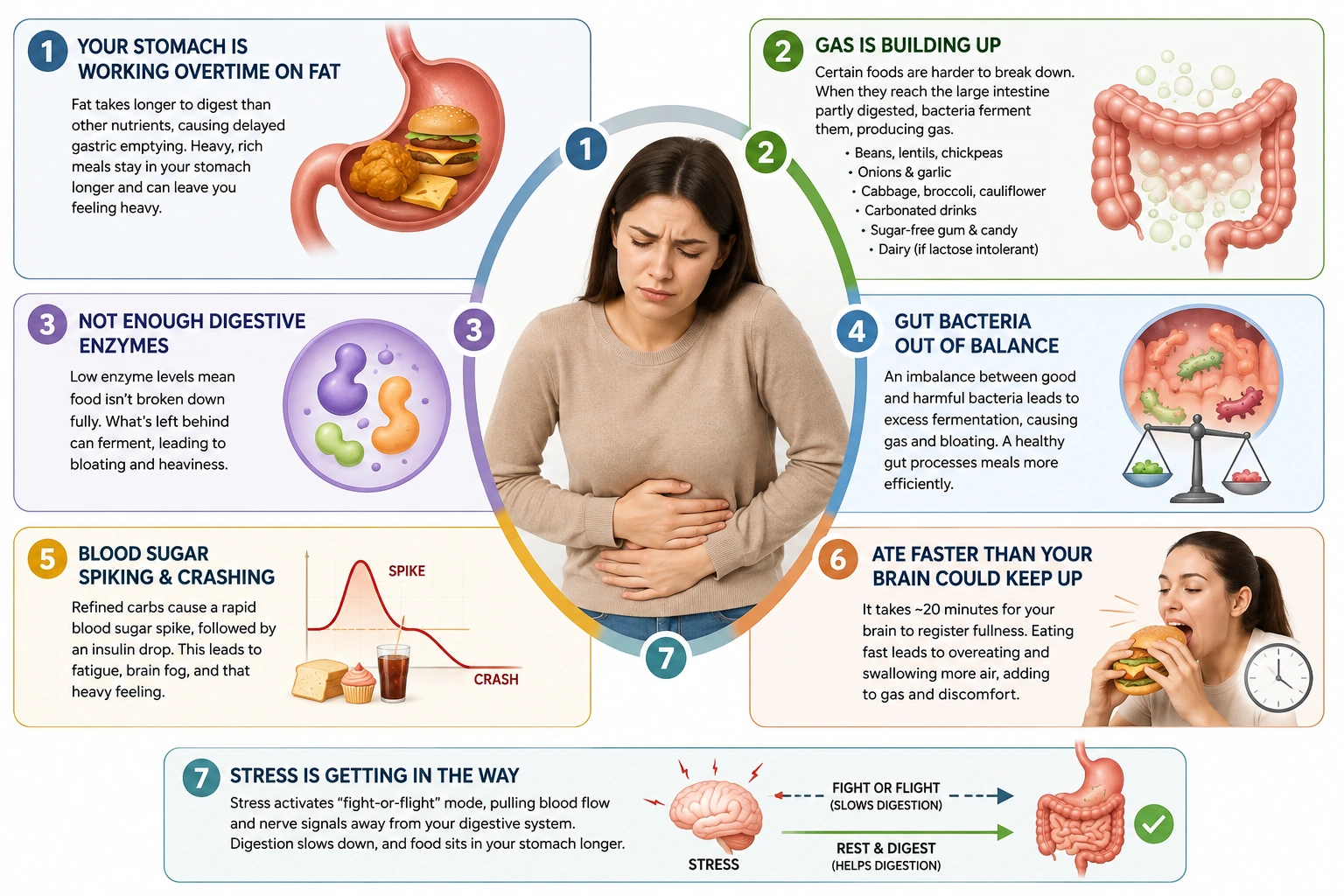
1. Your Stomach Is Working Overtime on Fat
Fat takes longer to digest than any other nutrient. A meal that’s heavy in fried food, cheese, or rich sauces sits in your stomach longer before it moves into your small intestine. Doctors call this delayed gastric emptying, and it’s one of the most common reasons a meal feels like it’s sitting like a rock. The bigger and richer the meal, the longer this takes, which is why a large fatty dinner tends to feel heavier than a light lunch.
2. Gas Is Building Up
Certain foods are harder for your gut to break down completely. When these reach your large intestine only partly digested, gut bacteria ferment them, which produces gas. That gas needs somewhere to go, and until it does, it adds to the pressure and heaviness in your belly. The most common triggers include:
- Beans, lentils, and chickpeas
- Onions and garlic
- Cabbage, broccoli, and cauliflower
- Carbonated drinks, including soda and sparkling water
- Sugar-free gum and candy sweetened with sorbitol or xylitol
- Dairy, if you’re sensitive to lactose
You don’t need to avoid all of these forever. Most people can handle small amounts without trouble. It’s usually the combination, a big plate with several of these at once, that causes noticeable gas and heaviness.
3. Your Body Doesn’t Have Enough Digestive Enzymes on Hand
Digestive enzymes are what break fats, proteins, and carbs into pieces small enough for your body to absorb. When enzyme levels run low, whether from age, stress, or just a particularly demanding meal, food doesn’t get broken down as fully. What’s left behind can sit and ferment, adding to bloating and that stuck feeling. This isn’t just theory: a two-month clinical trial found that people taking a multi-enzyme supplement reported real improvements in bloating and quality of life compared to a placebo group (Ullah et al., 2023).
4. Your Gut Bacteria Are Out of Balance
Your gut is home to trillions of bacteria, and the balance between the helpful and less helpful ones plays a real role in how smoothly digestion runs. When that balance tips the wrong way, food ferments more than it should, and gas and bloating follow. A well-balanced gut, on the other hand, tends to process meals more efficiently and comfortably. This is one of the biggest levers for long-term relief, and we’ll come back to it in the fixes section below.
5. Your Blood Sugar Is Spiking and Crashing
A meal heavy in white bread, pastries, sugary drinks, or other refined carbs causes a fast rise in blood sugar. Your body responds with a burst of insulin to bring it back down, and that swing can leave you feeling tired, foggy, and heavy about an hour later. This drop, sometimes called reactive hypoglycemia, is a big part of why a sugary lunch can leave you wanting a nap by 2pm.
It’s also closely linked to what researchers call postprandial somnolence, the general drowsy, heavy feeling that follows a big meal, especially one high in refined carbs or fat (Postprandial somnolence overview). Pairing carbs with protein, fiber, or healthy fat slows this rise and softens the crash, which is why a sandwich with lean protein and vegetables tends to sit better than a bagel alone.
6. You Ate Faster Than Your Brain Could Keep Up
It takes your brain roughly 20 minutes to register that you’re full. If you eat quickly, you can easily finish a meal before that signal arrives, which means you keep eating past the point of comfortable fullness. Fast eating also means swallowing more air, which adds gas on top of an already full stomach. Slowing down gives your body’s natural stop signals time to actually work.
7. Stress Is Getting in the Way
Digestion runs best when your body is calm. It relies on the vagus nerve, a long nerve that connects your brain and gut and switches on “rest and digest” mode. When you’re stressed, your body focuses on fight-or-flight instead, which pulls blood flow and nerve signals away from your stomach and intestines. Eating a meal while stressed, distracted, or rushing between tasks can leave digestion running at a fraction of its usual pace, which is part of why the same meal can feel very different on a calm day versus a chaotic one.
Feeling Heavy Right Now? Try This First
If you’re dealing with this right now and just want relief, start here:
- Get up and take a slow 5 to 10 minute walk. Even a short one helps move digestion along.
- Sip warm peppermint or ginger tea. Both have a long track record for easing stomach discomfort.
- Sit upright instead of lying down. Lying flat right after eating makes heaviness and reflux worse, not better.
These three steps won’t fix the root cause, but they’ll take the edge off while you wait for your meal to digest. For the longer-term fixes, keep reading.
10 Fixes That Actually Works
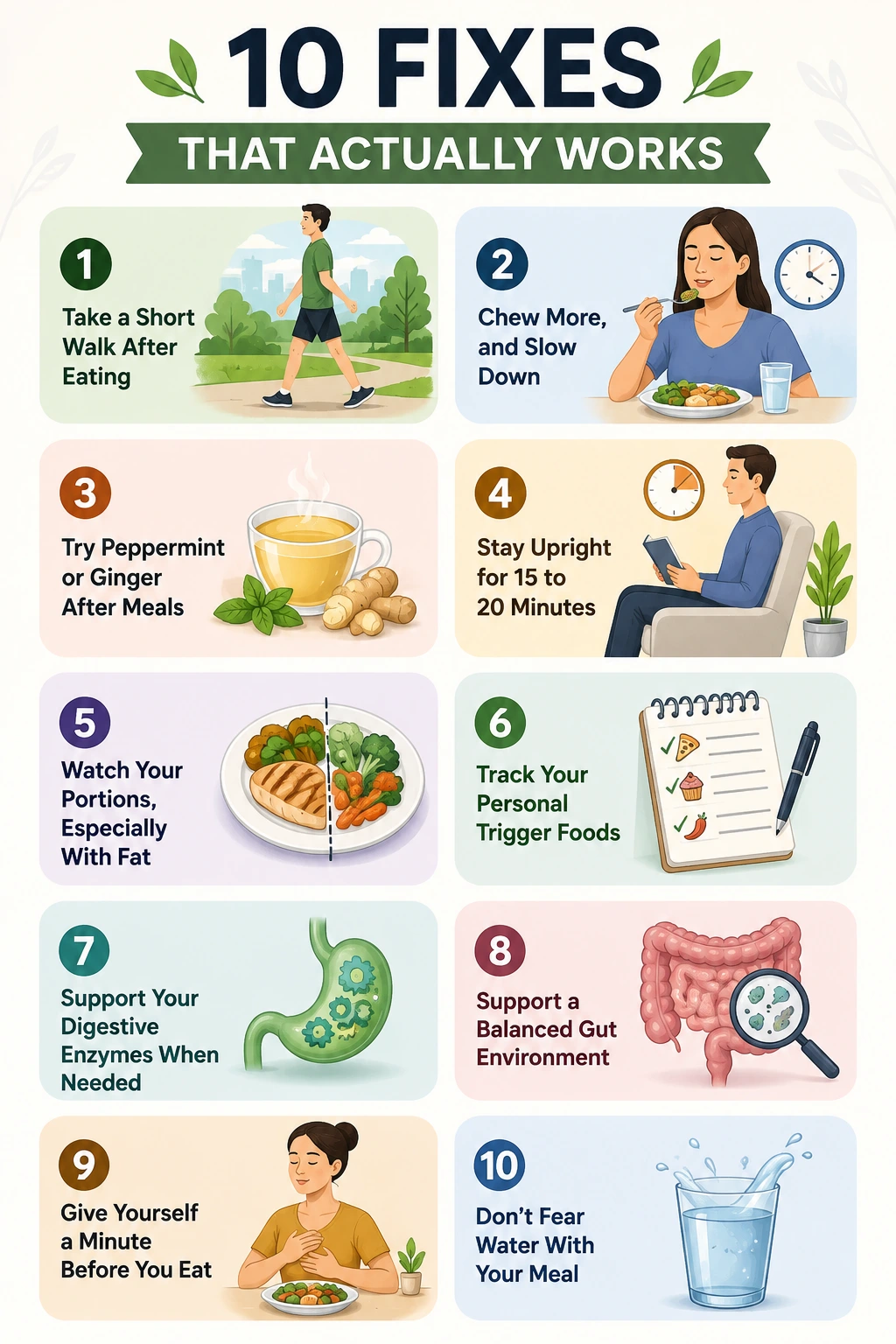
1. Take a Short Walk After Eating
This is one of the best-supported fixes on this list. A 2025 study found that a walk of just 10 minutes right after eating did more to blunt blood sugar spikes than a longer 30-minute walk taken later (Yamashiro et al., Scientific Reports, 2025). Aim to walk within 60 to 90 minutes of finishing your meal, at a pace that feels comfortable, not a workout.
2. Chew More, and Slow Down
Chewing does more than break food into smaller pieces. It mixes food with saliva, which contains enzymes that start digestion before food even reaches your stomach. Research shows that thorough chewing improves how well carbohydrates and proteins get broken down, and it also gives your fullness hormones time to catch up, so you’re less likely to overeat (Tandfonline systematic review, 2022). Try putting your fork down between bites if you tend to eat fast.
3. Try Peppermint or Ginger After Meals
Peppermint and caraway oil combinations have real clinical backing. A meta-analysis of five randomized trials involving 580 patients found meaningful improvements in stomach pain and overall dyspepsia symptoms compared to placebo, and the effect held up regardless of H. pylori status (Musial et al., 2022). Ginger has a similarly long history in easing an upset stomach, and it’s well tolerated even at higher doses over several weeks. A cup of peppermint or ginger tea after a heavy meal is a simple, low-risk way to use this. If you’d rather not brew tea, a piece of fresh ginger chewed slowly after a meal works in a similar way.
4. Stay Upright for 15 to 20 Minutes
Lying down right after a meal makes it easier for stomach contents, including acid, to move backward into your esophagus. A recent meta-analysis confirmed that sleeping or lying on your left side reduces reflux more than lying on your back or right side (Systematic review, 2023). The simplest habit: stay upright for at least 15 to 20 minutes after eating, and if you must lie down soon after a meal, favor your left side.
5. Watch Your Portions, Especially With Fat
Your stomach can comfortably hold about a liter of food before it starts to stretch uncomfortably. Large, fat-heavy meals are the most likely to push past that point, since fat takes the longest to digest and sits in the stomach while everything else backs up behind it. You don’t need to count every calorie. A simple trick is to fill half your plate with vegetables first, so there’s naturally less room left for the richest parts of the meal. If you’re eating out, consider splitting a heavier dish or boxing up half before you start rather than after you’re already full.
6. Track Your Personal Trigger Foods
Not everyone reacts to the same foods. Some people feel heavy after dairy, others after anything spicy or fried, and others after a completely different food that wouldn’t bother most people at all. Keep a simple note on your phone for a week or two of what you ate and how you felt an hour or two afterward. Include portion size and how fast you ate, not just the food itself, since the same meal eaten slowly versus quickly can produce very different results. Patterns usually show up within a week or two, and once you know your own triggers, you can manage them without cutting out entire food groups unnecessarily.
7. Support Your Digestive Enzymes When Needed
If heaviness and bloating show up often, low enzyme activity could be part of the picture. Clinical research on multi-enzyme supplements has shown reduced bloating and abdominal distension after meals in healthy adults, not just in people with diagnosed digestive conditions (Randomized crossover study, Dove Press). This is worth a conversation with your doctor if the pattern is frequent.
8. Support a Balanced Gut Environment
Since gut bacteria balance is one of the biggest drivers of post-meal heaviness, this is often where the most lasting improvement comes from. Randomized trials on specific probiotic strains have shown real reductions in bloating and abdominal discomfort over several weeks of consistent use (Bio-Kult trial, 2018; BV379 trial, 2025. But heaviness often starts higher up than people assume, in the stomach itself, not just the lower gut, so gut bacteria balance alone is only part of the picture.
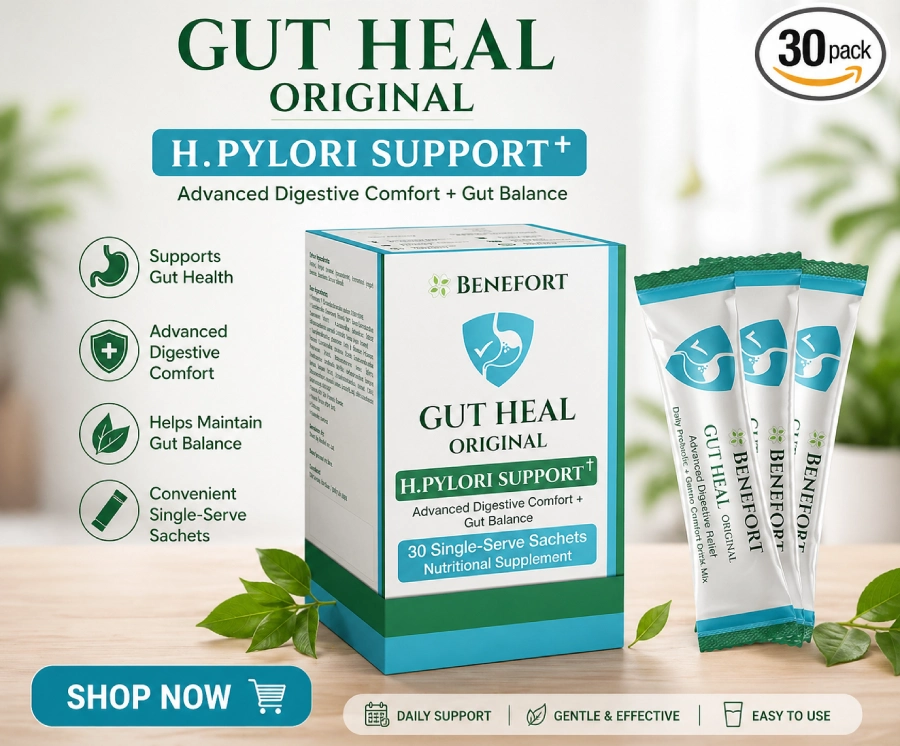
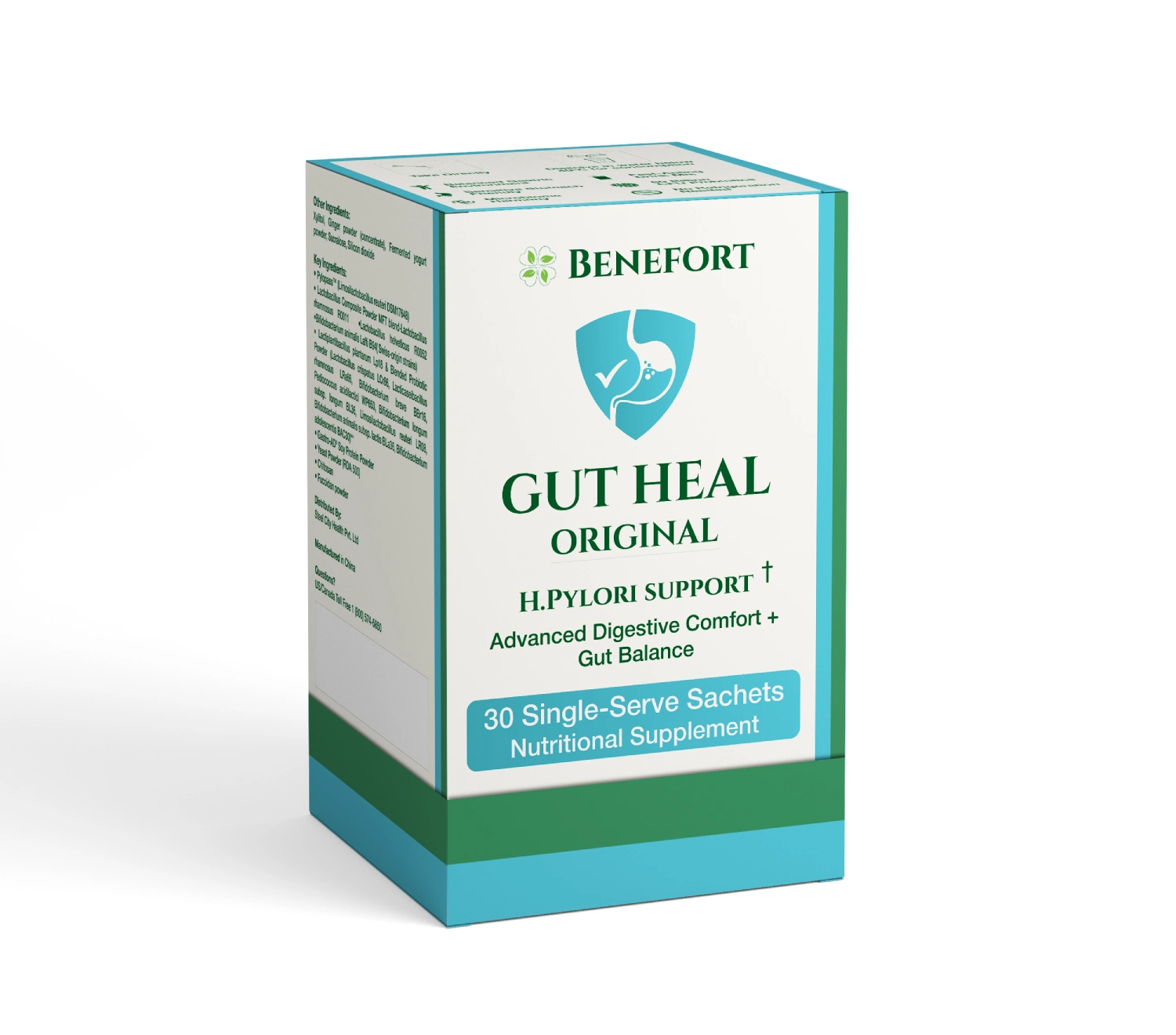
This is where a product like GUTHEAL Original with Pylopass (30 sachets per box) can fit into your routine. Clinical research on its core ingredient, Limosilactobacillus reuteri DSM17648, marketed as Pylopass, has specifically examined its role in supporting a balanced gastric environment, including in the context of H. pylori. The formula also combines Pylopass with Gastro-AD, a fermented soy complex studied for gastric comfort and easing occasional acid-related discomfort. Pairing these two together supports both the gut and the stomach, addressing both ends of the digestive tract rather than just one. It’s not a fix for a single heavy meal, but as part of a daily routine, it’s one option some people use to support their gut and stomach environment over time.
Support Gastric Comfort, Not Just Gut Balance
Heaviness often starts higher up than people assume, in the stomach itself, not just the lower gut. Gastro-AD, a fermented soy complex, has been studied for its role in supporting gastric lining comfort and reducing occasional acid-related discomfort. Pairing a stomach-targeted ingredient like this with a gut-balance strain like Pylopass addresses both ends of the digestive tract, upper and lower, rather than just one.
9. Give Yourself a Minute Before You Eat
Since stress pulls your body out of “rest and digest” mode, a short pause before eating can make a real difference. Take a few slow breaths, put your phone down, and sit for a minute before your first bite. This matters more than it sounds like it should: eating at your desk while answering messages, or grabbing food between back-to-back calls, keeps your nervous system in a state that isn’t built for digestion. A short pause tells your body it’s safe to shift gears, which in turn supports better digestion for the meal that follows.
10. Don’t Fear Water With Your Meal
A lot of people avoid drinking water with food because they’ve heard it dilutes stomach acid and slows digestion. As we’ll cover in the next section, this isn’t backed by evidence. Drink normally with meals unless your doctor has told you otherwise for a specific condition.
Myth Check: Does Drinking Water With Meals Slow Digestion?
This is one of the most repeated pieces of digestion advice, and it doesn’t hold up. Your stomach doesn’t have a fixed, limited amount of acid that water can water down. It produces acid based on what you eat and drink, adjusting automatically to keep digestion working. Registered dietitians who specialize in gut health note that water doesn’t meaningfully dilute digestive enzymes or acid, and in most people it doesn’t slow digestion at all (The Gut Health Doctor). The one exception worth knowing: if you already deal with acid reflux, drinking a large volume of liquid with a meal can add extra pressure in your stomach and make symptoms worse, simply because of added volume, not because the water itself is a problem.
When to See a Doctor
Feeling heavy after a big meal now and then is completely normal, and it’s not something you need to bring up at your next checkup on its own. It’s worth getting checked out if you notice any of the following:
- You feel full very quickly, even with small meals, and this pattern is new or getting worse
- You’re losing weight without trying to
- You vomit food that looks undigested, hours after eating
- Fullness comes with severe abdominal pain
- Heaviness comes with a burning feeling in your chest or a sour taste in your mouth on a regular basis, which can point to acid reflux
- The pattern has lasted for several weeks despite trying the fixes above
None of these automatically mean something serious is going on. Many turn out to be manageable conditions like acid reflux, a food sensitivity, or slow gastric emptying, all of which respond well to treatment once identified. But they’re worth a conversation with a doctor rather than something to manage on your own indefinitely, especially if the pattern is new or worsening.
You don’t need to eat all of these every day. Adding a few of them regularly tends to make a bigger difference than trying to do everything at once.
Quick Answers
Why do I feel heavy after every meal?
Feeling heavy after most meals usually points to slow digestion, eating fast, large portions, or a gut bacteria imbalance. It is common and often fixable with small changes to how and what you eat.
Is it normal to feel heavy after eating?
Yes, mild heaviness for an hour or two after a big meal is normal. It becomes a concern if it happens after small meals, lasts for hours, or comes with pain, vomiting, or weight loss.
How long does the heaviness after eating last?
Heaviness typically peaks about an hour after eating and eases over the next two to four hours as digestion continues.
Does walking after eating help digestion?
Yes. Even a 5 to 10 minute walk within 60 to 90 minutes of eating can lower blood sugar spikes and ease bloating.
Can gut bacteria affect how heavy I feel after eating?
Yes. An imbalanced gut environment can slow down how well food is broken down, leading to more gas, fermentation, and that heavy feeling. Supporting gut bacterial balance, through diet or targeted probiotic strains, may help.
Feeling heavy after eating usually isn’t one thing, it’s a mix of what you ate, how fast you ate it, and how your gut is doing behind the scenes. Start with the quick fixes when you need relief today, and build in a few of the longer-term habits, like slowing down, walking after meals, and supporting your gut bacteria, for changes that stick. None of these require a complete diet overhaul. Most people see a real difference just from picking two or three habits from this list and sticking with them for a few weeks, rather than trying to change everything about how they eat at once.
References
- Ullah H, et al. Efficacy of digestive enzyme supplementation in functional dyspepsia: a randomized, double-blind, placebo-controlled trial. ScienceDirect, 2023. https://www.sciencedirect.com/science/article/pii/S0753332223016566
- A Multi-Digestive Enzyme and Herbal Dietary Supplement Reduces Bloating in a Single Use in Healthy Adults: A Randomized, Placebo-Controlled, Cross-Over Study. Dove Press. https://www.tandfonline.com/doi/full/10.2147/NDS.S453377
- Ishaque SM, et al. A randomized placebo-controlled clinical trial of a multi-strain probiotic formulation (Bio-Kult) in diarrhea-predominant IBS. BMC Gastroenterology, 2018. https://www.ncbi.nlm.nih.gov/pmc/articles/PMC5970461/
- Dietary Supplementation with the Probiotic Bacillus velezensis BV379 Decreases Abdominal Bloating: A Randomized, Double-Blind, Placebo-Controlled Trial. Taylor & Francis, 2025. https://www.tandfonline.com/doi/full/10.1080/27697061.2025.2563894
- Yamashiro K, et al. Positive impact of a 10-minute walk immediately after glucose intake on postprandial glucose levels. Scientific Reports, 2025. https://www.nature.com/articles/s41598-025-07312-y
- Chewing and its influence on swallowing, gastrointestinal and nutrition-related factors: a systematic review. Taylor & Francis, 2022. https://www.tandfonline.com/doi/full/10.1080/10408398.2022.2098245
- Left lateral decubitus sleeping position and gastroesophageal reflux disease symptoms: a systematic review and meta-analysis. PubMed, 2023. https://pubmed.ncbi.nlm.nih.gov/37969463/
- Menthacarin (peppermint oil and caraway oil combination) in functional gastrointestinal disorders: a systematic review and meta-analysis. PubMed, 2022. https://pubmed.ncbi.nlm.nih.gov/36502789/
- Drinking water with meals: yay or nay? The Gut Health Doctor. https://theguthealthdoctor.com/drinking-water-with-meals-yay-or-nay
